LicensedInsuredFamily-owned40 years of experience100% satisfaction guarantee
Residential service
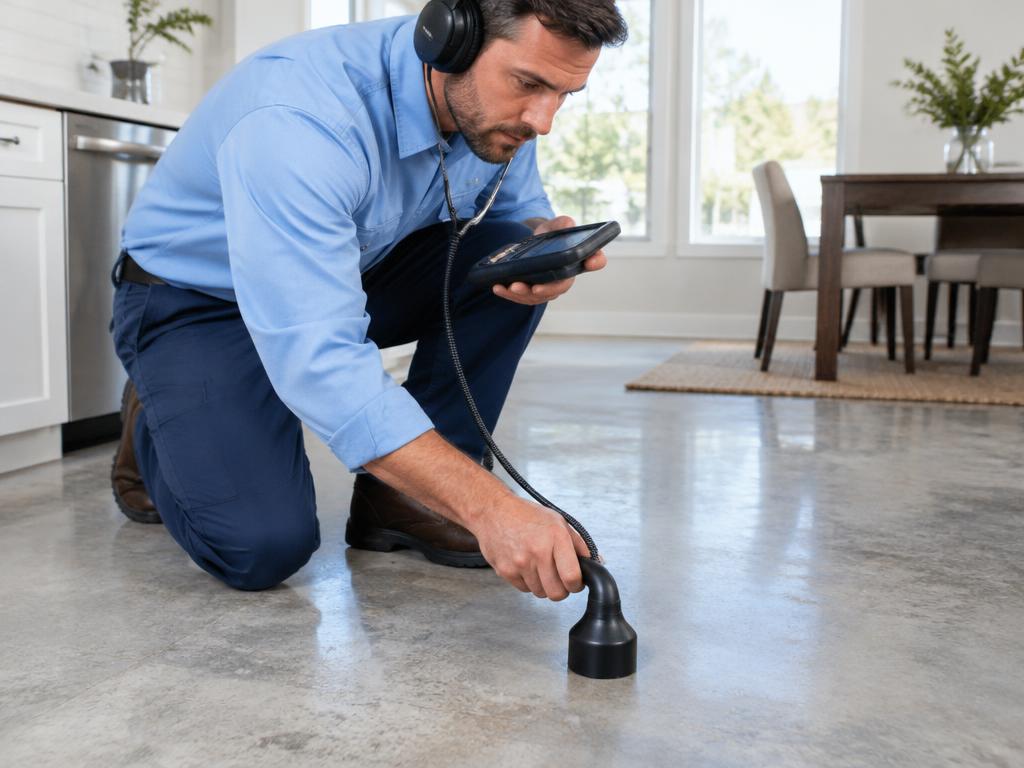
A slab leak is the most expensive plumbing problem you can ignore. We use acoustic listening, pressure testing, and line tracing to narrow the leak location. Locating manifolds helps us plan access and minimize unnecessary drywall damage before recommending repair or rerouting.
Talk to a master plumber
Call for slab leak detection & repair anywhere in Denton County.
214-287-0445Acoustic listening, pressure testing, line tracing, and locating manifolds help identify the affected line and plan access without opening walls unnecessarily.
A targeted accessible pipe repair or a planned reroute, followed by pressure testing. We explain required floor or wall openings before work begins.
Why it matters
A leak under your foundation never stays small. Water escaping beneath the slab erodes soil, can shift the foundation, encourages mold, and quietly runs up your water bill. Because the pipe is buried, guessing is expensive — accurate detection matters more here than almost anywhere else in plumbing. Finding the exact spot first means a smaller repair, less demolition, and a fix that actually holds.
We rule out fixtures, irrigation, and other sources, then pressure-test the system to verify a buried line is actually losing water before anyone talks about opening the floor.
Acoustic listening helps narrow the leak location, pressure testing identifies the affected supply, and line tracing maps the route. Locating manifolds helps us isolate connected lines and choose access points that minimize unnecessary drywall damage.
For an isolated break, a targeted repair through a small opening may be best. For a line with a history of failures, rerouting around the slab avoids cutting concrete entirely. We walk you through both options with pricing before work begins.
A high bill or damp floor alone does not prove a slab leak. Fixture leaks, irrigation, and other supply problems should be considered too. Pressure testing and leak-location methods help determine whether a buried water line is involved and where access may be needed.
A targeted repair may make sense for an isolated break. Rerouting or replacing a section can be worth discussing when access is difficult or the line has a history of failures. The best option depends on pipe condition, layout, and the disruption each approach would cause.
Note when you first noticed the symptoms and gather recent water bills if available. If you suspect a leak, you may need to shut off the main water supply to limit damage. Only operate an accessible shutoff if it is safe; do not force a stuck valve or enter water near electrical equipment. Call us for guidance while you wait.
Investigate unexplained changes in water use early. Have abnormal supply pressure evaluated, and keep a record of previous buried-line repairs to help spot a pattern.
FAQ
Not always. Depending on the layout, a line may be rerouted rather than accessed through the slab. Diagnosis comes first so the practical options can be compared.
Coverage varies by policy and cause. Ask your insurer about resulting damage, leak access, and pipe repair separately; do not assume they are covered together.
It is a warning sign, not a diagnosis. Testing is needed to distinguish a leaking hot-water line from other heat or moisture sources.
Word of mouth
Read current, verified customer feedback on Jensen Plumbing's Google Business Profile.
Read Google reviews